
Your tenancy
The archive, its index and every generated draft live in your organisation’s own cloud tenancy. Each organisation is isolated at the database level; a connection that hasn’t identified its organisation sees nothing at all.
Your cloud
Proposals contain your rates, your people’s licence numbers and your clients’ names. MinerSOQ keeps all of it inside a tenancy that belongs to your organisation, and is explicit about what a model call sees.
The archive, its index and every generated draft live in your organisation’s own cloud tenancy. Each organisation is isolated at the database level; a connection that hasn’t identified its organisation sees nothing at all.
Generation runs on a hosted model under your organisation’s licence, with a monthly budget you set and usage you can see. Neither the browser nor the desktop ever holds a model key.
For firms where nothing may leave, generation can run on a local model inside your own network. The pipeline, the verification and the audit are the same; only where the model runs changes.
People sign in with the identity provider they already use. Seats are named, groups map to disciplines or offices, and collections and grants decide who can see which part of the archive.
What a model call sees
Each section is generated from the request, the pursuit inputs, the firm facts the section needs, an excerpt of the RFQ, and the evidence retrieved for that section under the caller’s own access rights.
What stays put
Every query — a person’s search, a generator’s retrieval, an administrator’s audit — is scoped by row-level security in the database itself. A document outside your grants is absent, not hidden. Credentials for connected sources are encrypted at rest with rotating keys, and operational logs carry identifiers and counts, never document text or paths.
The firm profile
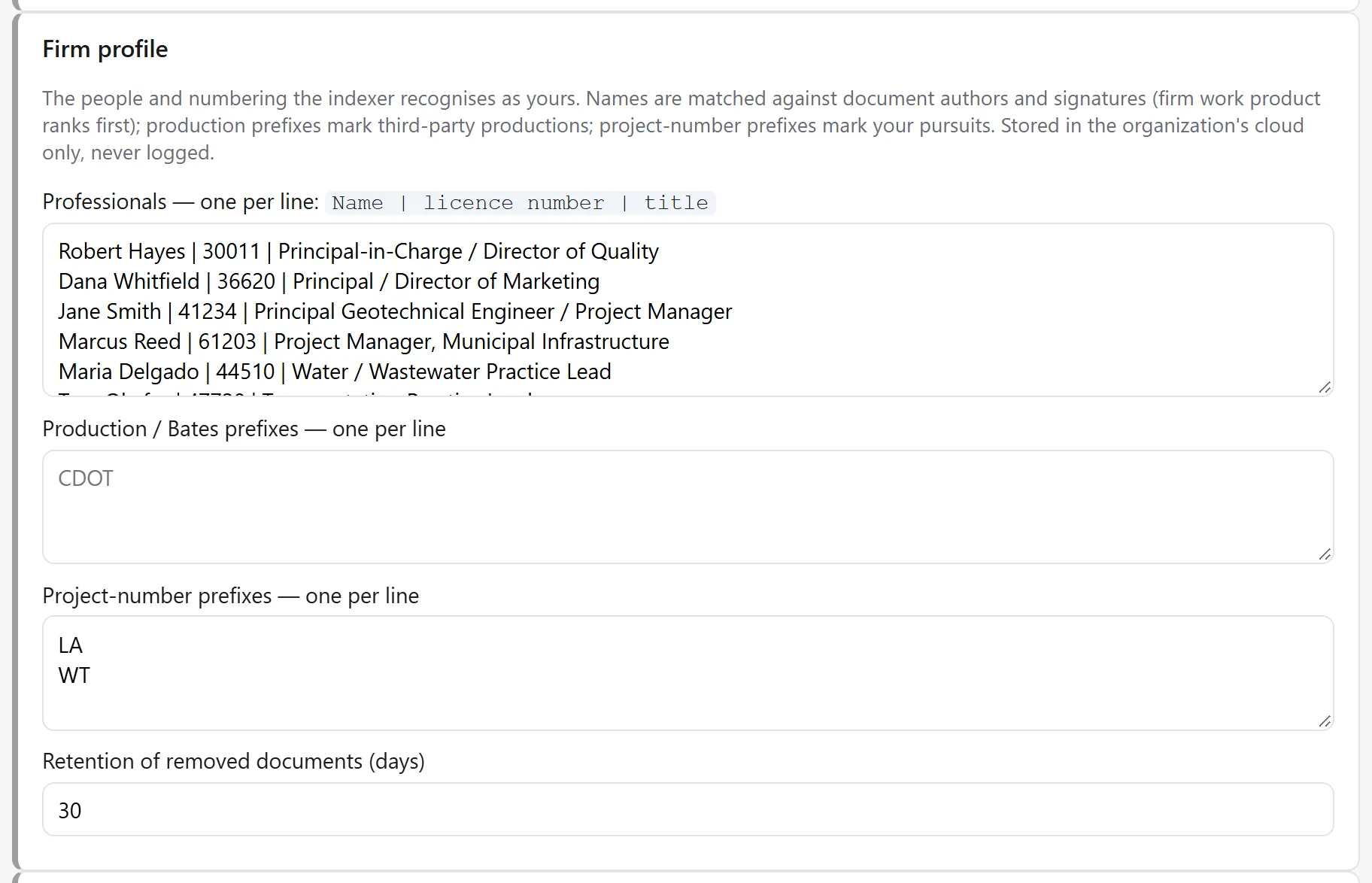
An organisation administrator maintains one profile of firm facts. Fee, rate, insurance and overview sections may state numbers from it and from nowhere else; anything absent renders as a flag rather than a guess.
names, titles and PE licence numbers — the only source a resume’s registration line can come from
your prefixes, so the classifier recognises the firm’s own project numbers on sight
addresses, phones and staff by discipline for the firm overview
DBE status, DOT prequalifications, accredited laboratories
hourly rates by role, with an effective date, for every fee matrix
the coverages a submittal must state, stated once
your standard terms, quoted verbatim
header and footer text for the Word document
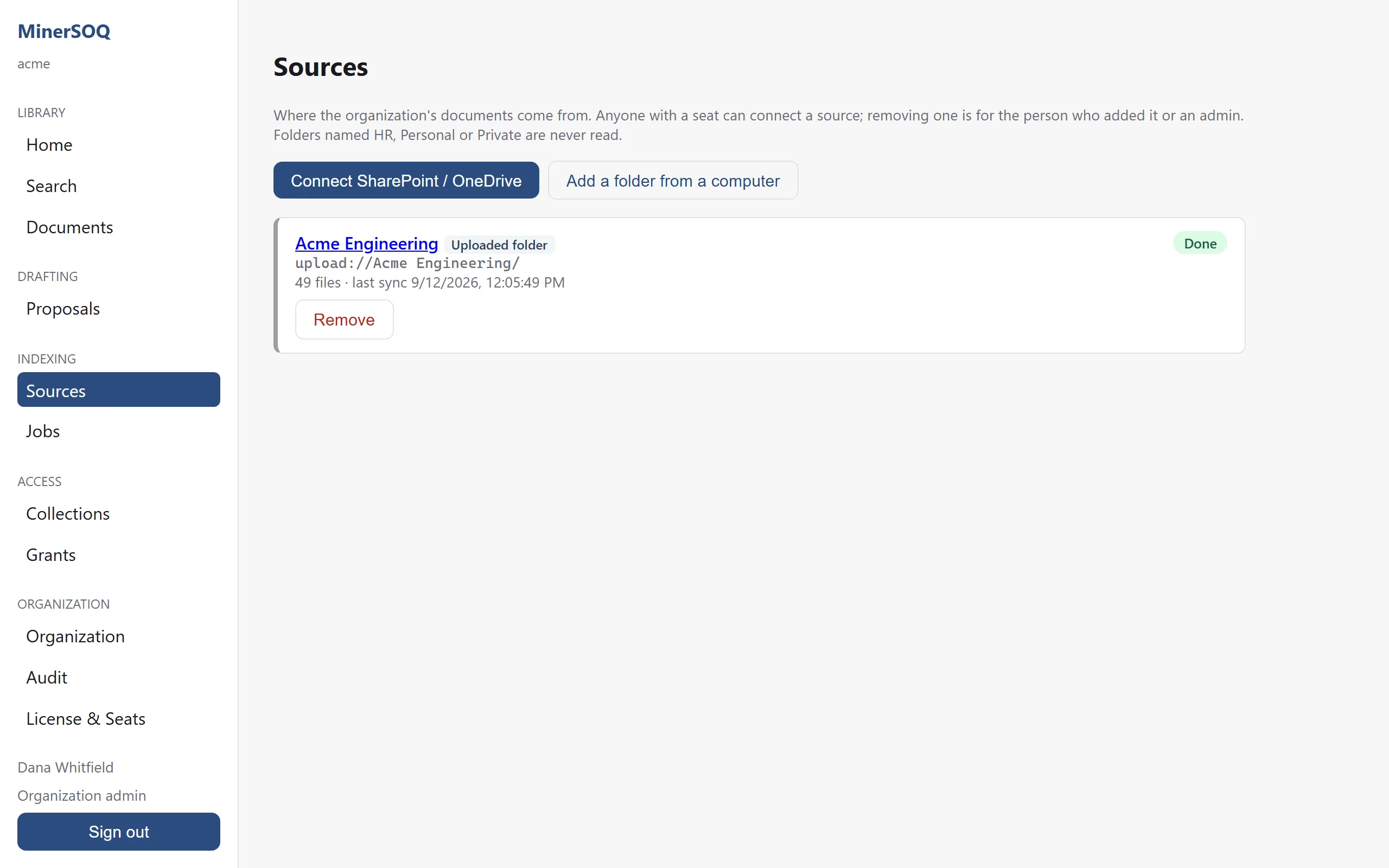
Sources
Connect SharePoint or OneDrive once and change tracking keeps the index current — new project sheets and the SOQ you sent last week show up without anyone re-uploading. A shared drive that isn’t in the cloud yet is uploaded from the desktop.
Administration
Organisation administrators manage the licence and its seats, collections and grants, and the organisation’s own audit log, which is itself a tamper-evident chain that can be verified on demand.
Tenancy, access control, what crosses the wire and what never does — we would rather answer it in detail before a pilot than after.